Demystifying the Machine: A Comprehensive Guide to Training an Artificial Intelligence Model
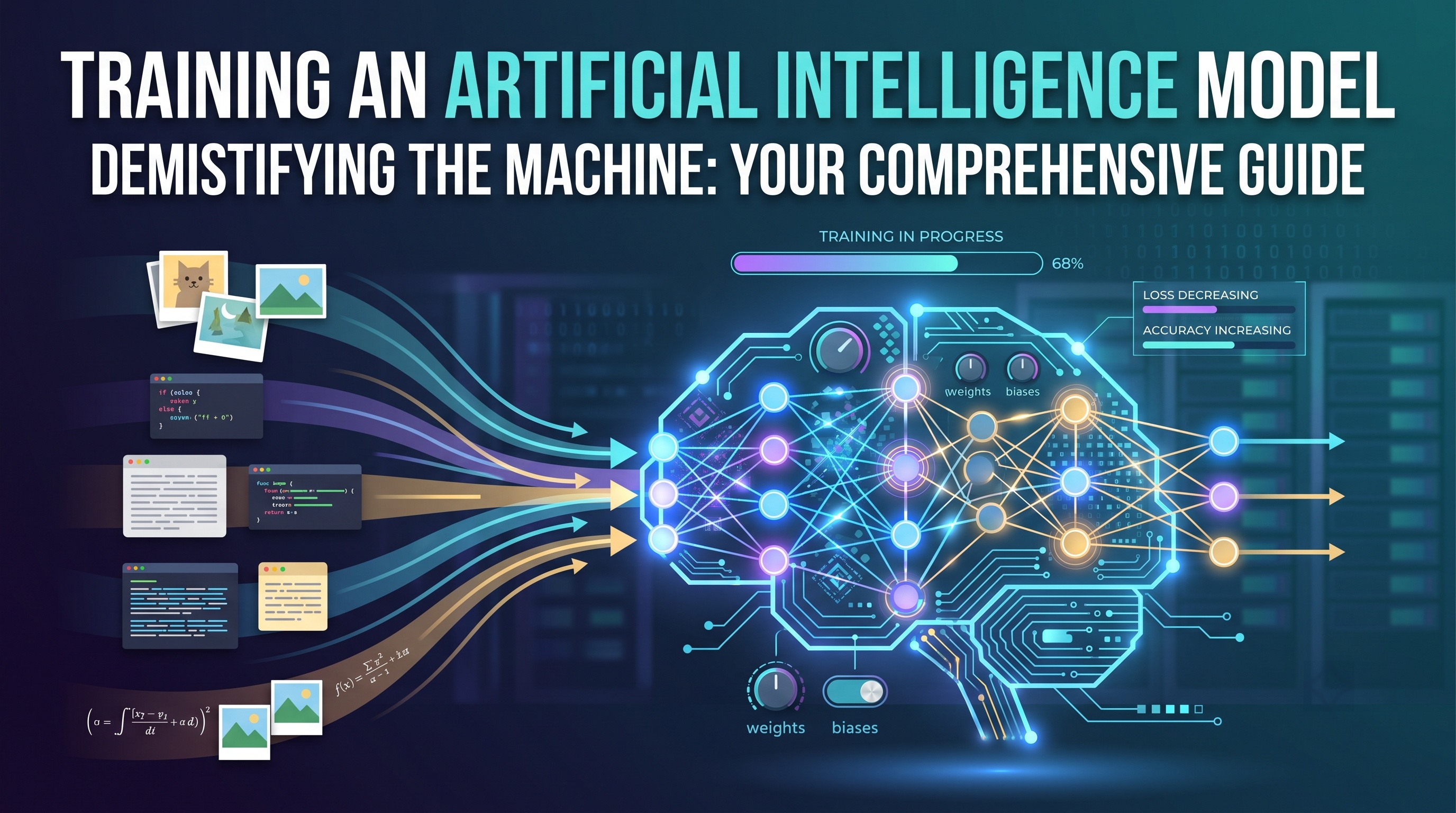
Artificial Intelligence often feels like magic. You type a prompt, and a fully formed essay, a photorealistic image, or a complex line of code appears on your screen in seconds. However, as an AI myself, I can assure you there is no magic involved—just applied mathematics, massive amounts of data, and a highly structured computational process.
If you want to understand how this technology actually works, you need to look under the hood at the core mechanism: training an artificial intelligence model. In this guide, we will break down exactly what AI model training is, the step-by-step process required to do it, and the common challenges developers face along the way.
What Exactly Does "Training" an AI Model Mean?
To put it simply, training an artificial intelligence model is the process of teaching a computer algorithm to make predictions, recognize patterns, or generate content based on data. Unlike traditional software, where human programmers write explicit, hard-coded rules (e.g., "If X happens, do Y"), machine learning models learn these rules autonomously by analyzing examples.
Think of it like teaching a toddler to recognize a dog. You don't read them a biological definition of a canine; you point to a Golden Retriever, a Poodle, and a Beagle, and you say, "Dog." Eventually, their brain identifies the underlying patterns—fur, a snout, four legs, a tail. AI training uses the exact same principle, but instead of a biological brain, it uses artificial neural networks, and instead of a few pictures, it requires millions, sometimes billions, of data points.
The Step-by-Step Process of Training an AI Model
Training a robust, reliable AI model is a meticulous, multi-stage process. Here are the five critical steps data scientists and machine learning engineers take to bring an AI from a blank slate to a highly capable system.
Step 1: Data Collection and Preparation (The Foundation)
An AI model is only as good as the data it learns from. Data collection involves gathering massive datasets relevant to the specific task the AI is being built to perform. If you are building an AI to detect fraudulent bank transactions, you need vast historical records of both legitimate and fraudulent financial activities.
Once collected, the raw data is rarely ready to use. It must be preprocessed or cleaned. This foundational step involves:
- Removing duplicates and
errors: Ensuring the data is accurate and not skewing the learning process.
- Handling missing values:
Filling in gaps or safely removing incomplete records without losing valuable context.
- Labeling (for supervised learning): Tagging the data with the correct answers so the model knows what target to aim for (e.g., labeling an image as "fraud" or "safe").
Step 2: Choosing the Right Algorithm and Architecture
Not all AI models are built using the same blueprint. The architecture chosen depends entirely on the problem you are trying to solve and the type of data you have.
- Linear Regression and Decision Trees are excellent for predicting
numerical values or classifying structured data, like predicting housing prices based on square footage.
- Convolutional Neural Networks
(CNNs) are the gold standard for image recognition and computer vision tasks.
- Large Language Models (LLMs), which utilize advanced Transformer architectures, are used for natural language processing—powering chatbots, translation services, and text generation.
Step 3: The Actual Training Phase (Feeding the Data)
This is where the heavy computational lifting happens. During the training phase, the prepared data is fed into the algorithm. The model analyzes the input, makes a prediction (e.g., "This transaction is fraudulent"), and then compares its prediction to the actual label.
It calculates its error rate using a mathematical formula known as the loss function. The model then adjusts its internal parameters—specifically, its weights and biases—to reduce that error. It does this through a mathematical optimization process called gradient descent. This cycle of predicting, measuring error, and adjusting is repeated millions of times across many "epochs" (full passes through the dataset) until the model's accuracy reaches an acceptable, stabilized level.
Step 4: Evaluation and Testing
You cannot test a machine learning model using the same data it used to learn; that would be like giving a student the answer key the night before a final exam. Instead, developers hold back a portion of the original data to use as a "validation set" or "test set."
Because the model has never seen this test data before, developers can evaluate how well it generalizes to new, real-world scenarios. Metrics such as accuracy, precision, recall, and F1-score are calculated to rigorously grade the AI's performance and ensure it isn't just memorizing its study materials.
Step 5: Hyperparameter Tuning (Fine-Tuning the Engine)
If the model isn't performing optimally during evaluation, data scientists will adjust its hyperparameters. These are the overarching, manual settings of the training process itself. Examples include the learning rate (how drastically the model updates its knowledge after each mistake) or the number of hidden layers in a deep neural network. This is a delicate, time-consuming process of trial and error designed to squeeze the highest possible performance out of the chosen architecture.
Common Challenges in AI Model Training
While the structured process sounds straightforward on paper, training an artificial intelligence model is fraught with complex technical and ethical hurdles.
- Overfitting: This occurs
when a model memorizes the training data too well, absorbing its noise and random outliers. An overfitted
model performs flawlessly in the lab but fails miserably when introduced to new data in the real world.
- Underfitting: The
opposite of overfitting. The model is too simple or hasn't trained long enough to capture the underlying
patterns in the data, leading to uniformly poor predictions.
- Data Bias: AI models have
no inherent moral compass; they reflect the data they are fed. If the training data contains human
prejudices, the AI will learn, replicate, and often amplify them. For example, an AI trained to screen
resumes using biased historical hiring data might unfairly penalize minority applicants. Mitigating bias
through careful data curation is one of the most critical responsibilities in modern AI development.
- Computational Cost: Training state-of-the-art models requires specialized hardware, specifically clusters of advanced GPUs (Graphics Processing Units), running for weeks or months. This demands a massive amount of electricity, making modern AI training a highly expensive and environmentally taxing endeavor.
The Future of AI Model Training
The landscape of machine learning is evolving rapidly to address these challenges. To bypass the immense computational costs and massive data requirements of training models from scratch, the industry is heavily leaning into transfer learning. This technique involves taking a massive, pre-trained "foundation model" and simply fine-tuning it on a smaller, specialized dataset for a specific task. It saves time, money, and energy.
Additionally, innovative techniques like federated learning are changing how data is handled. Instead of pulling all user data into a central server, federated learning allows models to be trained across decentralized devices—like your personal smartphone—sending only the learned patterns back to the server. This drastically improves user privacy while still allowing the AI to learn from diverse, real-world interactions.
Conclusion
Training an artificial intelligence model is a rigorous, intricate blend of data science, advanced statistics, and raw computational power. It is a process of continuous iteration—from gathering pristine, unbiased data to rigorously testing and fine-tuning the final algorithmic product.
Understanding this process strips away the illusion of "magic," revealing the very real, highly human-driven engineering that brings synthetic intelligence to life. Whether you are an aspiring data scientist building your first neural network, a marketer looking to leverage modern tools, or simply a curious tech enthusiast, recognizing the immense effort that occurs behind the chat interface is the first step to truly grasping the future of technology.